
Introducing Neurodiversity
+ a guest essay by Prateebha Tuladhar

It’s been slightly over a year since I took a couple of online tests which indicated, quite strongly, that I might be neurodiverse. I’d been learning about the neurodiverse world, as well as acquainting myself with alternative therapeutic models such as Narrative Theory, from a close friend, a professional therapist who continues to study, explore and work with individuals on the autistic spectrum. The website linked above containing the tests were recommended by her primarily because it’s designed by experts and scholars who also identify as being autistic. Unsurprisingly, until very recently, autism was studied and diagnosed by neurotypical, mostly Western men. Dominant discourses around autism hence tend to pathologize and there continues to be much stigma and misunderstanding regarding what it is and how it manifests in daily lives, not unlike discourses surrounding homosexuality.
The knowledge I gained while going through the questionnaires and by reading various articles has been deeply transformative. Embracing this new possibility - which entails re-membering, reviewing and re-authoring key moments and relationship dynamics from my past - has been very liberating and a relief. There are entire theories describing how autistic identity is experienced differently. For example Terra Vance explains how the idea of justice is extremely important to most neurodiverse people, a deeply held value that might even cost formal relationships. If, on top, autistic people also happen to be queer, the reader can imagine how these neuroqueers might have values completely different from mainstream society. Nick Walker coined the term ‘neuroqueer’ in the early 2010s. Their website details their journey, and includes an eight-point definition of the term. I was quite encouraged by this description:
Engaging in practices intended to undo and subvert one’s own cultural conditioning and one’s ingrained habits of neuronormative and heteronormative performance, with the aim of reclaiming one’s capacity to give more full expression to one’s uniquely weird potentials and inclinations.
And so I launched this Substack, even naming it after this new energizing concept, hoping to reclaim my weirdness. I wanted to jot down weird reflections based on art shows and make weird connections to current events or literary essays. As you can read from my brief Substack About page, I cast a pretty wide net. But I hadn’t written directly about neurodiversity until now. My therapist friend was reassuring. ‘Everything you do is neurodiverse’, she inferred. ‘Your reflections, choices and projects are all expressions of your neurodiversity.’
But as an educator, I do think it’s important to begin talking more openly about this widely overlooked terrain in Nepal. And so, I’ll start today by sharing an article written by journalist Prateebha Tuladhar which was published earlier this year.
Before that, a much-overdue acknowledgement to Nick Walker for coining the term ‘neuroqueer’. The readers now know that my Substack logo is actually lifted from their website. I couldn’t resist it.
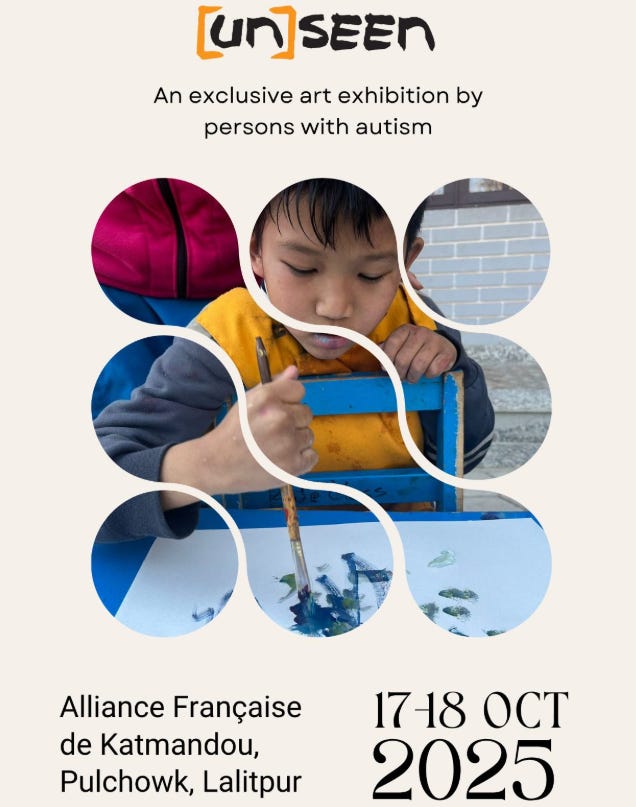
And for those interested, the Alliance Française of Kathmandu is hosting an art exhibition by persons with autism this weekend, in collaboration with Aakar Foundation.
Raising Autistic Children: A mother’s perspective
- by Prateebha Tuladhar
Autism is a topic close to my heart, because many people in my life are on the spectrum or caring for people who are. My friend Bhavna Adhikari and my sister Loonibha Tuladhar are both mothers to autistic children. And their challenges are aplenty.
Their parenting concerns are very different from those of other mothers I know, the first challenge being navigating the dearth of knowledge on autism in Nepal. Loonibha often says that whenever she has to tell someone that her son is on the spectrum, she has to explain how children with autism think differently and so they behave differently and have to be treated with kindness.
Bhavna concurs: ‘Autistic people or people with autism, their brains are wired differently; they think differently, they interact differently. Because they don’t fit into the mould created by society to interact, behave and communicate in a certain way, they’re frowned upon.’
Over time, the term ‘autism’ has also come to be replaced by broader terms such as ‘neurodivergent’ and ‘neurospicy’ (a lighthearted phrase to describe neurodivergence), alluding to how diverse the traits and experiences of people on the spectrum are.
People on the spectrum do not refer or conform to norms prescribed by wider society, which makes their life challenging and makes society see them as a challenge. There are societies that don’t even recognise or acknowledge autism. In the Nepali language, there is no word equivalent to ‘autism’ or terms that describe such a condition—socially, it is unacknowledged and therefore rejected.
According to Autism Care Nepal Society, there are 300,000 autistic persons in Nepal, among them around 90,000 severely affected.1 News reports have shown how autistic children in some remote parts of the country are sometimes restrained by their families.2 This stems from a lack of understanding of their condition as well as the inability to provide care, because of poor access to healthcare.
In the cities, where health services are more accessible, attention to issues like autism are still not always a priority. For Bhavna and Loonibha, they always knew their children were different, and they weren’t as worried about the diagnosis as much as they were about how society would receive their children or what kind of education and career opportunities they would have.
It was when Bhavna was studying for her master’s degree in Australia that she got a full diagnosis for her son, Drishtant, for autism spectrum disorder (ASD). ‘I would go to the bathroom and cry. What would his future look like? That’s the worry for most parents. It’s not the day-to-day struggle so much as his future,’ explains Bhavna. ‘My concern is more around the fact that he’s not going to have a social circle, a career like we do, or a family. That worries me. I always have to be there for him.’
When children do not meet learning milestones in junior school, it starts to become a concern. Now, more and more schools are asking parents to get their children diagnosed when they show signs of neurodivergence. But an autism therapist I spoke to recently said that in a country like Nepal, diagnosis doesn’t provide much relief because there are no provisions to help children with special needs, and in fact only adds to the burden the parents and the child must bear.
‘People tell me not to tell others he’s autistic, that there will be a stigma against him. But if we don’t talk about it how will the situation ever improve?’ Loonibha questions. Her son, Paartha, is now nine years old and was diagnosed with ASD and attention deficit hyperactivity disorder (ADHD) when he was four. ‘If we hide it and do not help people understand and educate them on autism, how will my child adjust socially? What kind of environment will schools give him? What kind of skills will he learn?’
Paartha has been subjected to discrimination by relatives and strangers on multiple occasions, as has Drishtant. Both mothers have in the past been asked to remove their child from certain events or weren’t even invited in the first place. When autistic children are seen stimming (performing repetitive behaviours or motions to help cope with emotions) or having meltdowns, neither of which can be helped, they tend to be misunderstood by people as problem children.
Autistic children don’t understand social cues, and schools are wary of enrolling students who are different because of the extra management needed to handle them. That is exactly what needs to change about the education system, Bhavna says.
‘When we talk about social inclusion, we aren’t just talking about race or gender. We are also talking about accepting all kinds of people with limitations and disabilities. And schools have to teach that,’ says Bhavna, who even took a couple of years off work at one point to tutor her son.
Drishtant, now 17, attends Phoenix School in Kathmandu, one of the very few schools in the country that accepts all children. Discovering the school was a relief for Bhavna, who initially struggled to find somewhere to send her son.
‘People think kids with special needs should go to a special school. I find that problematic. They have to be going to a mainstream institution because outside of school, they’re part of the same society. The so-called “normal” people have to understand there are all kinds of people and everyone should be accepted,’ says Bhavna.
The first time she walked into Phoenix School, she spotted a girl in a wheelchair among the other children. There were all kinds of students in the school, and she decided then and there that was the school she would send her son to.
Loonibha picked the school for her child for the same reason and says neurotypical children should be taught to live with those who have special needs, because that’s the only way they can learn to build an inclusive society. She is proud whenever Paartha comes home and shares how he gave his seat to someone else because that child was in more need than him. That kind of education is just as important as other skills she expects him to learn, she says.
Both Drishtant and Paartha struggle with reading and writing comprehension, but excel at breaking down concepts, and immerse themselves in topics that interest them. And as Drishtant prepares to complete 10th grade next year and graduate, Bhavna’s concerns about his future have intensified.
‘I don’t know what his future will be after 10th grade. I’m worried; he loves his school. I really wish for more schools that don’t just manufacture a workforce, but build an inclusive, wholesome education system,’ she says.
Loonibha shares similar concerns for Paartha. Neither women have the privilege of considering their child’s grades a priority. Instead, they revel in small wins like when their child buttons their shirt correctly, zips up their jacket, ties their shoelaces or flushes the toilet after use. While for most parents, success is measured in their child’s academic achievements, for mothers whose children have special needs, success revolves around them being able to take care of themselves in future. That’s where the role of education comes in. Schools are the first external environment children experience away from their home, and that space has to be safe.
Drishtant used to want to be a game developer or a carpenter. At the moment, he is reassessing his plans. Paartha often says he wants to be a biologist, but he’s only just learning to read and write and it’s going to be a long road for him, something his teachers and parents understand.
Nepal’s education system currently follows a structure where the students are expected to pass a written examination at the end of every academic year in order to advance. The students who do well are those who are able to read and write. Others who don’t conform to these standards get left behind.
‘We need an educational system that is willing to change. Not all children can sit down for three hours to take a written exam, and it takes away opportunities from children who have disabilities. We need to create exams that suit everyone, like verbal assessments or assistance with writing down answers,’ Loonibha argues.
‘I can’t imagine he will be successful in his career and be this and that, I just hope Drishtant is able to take care of himself,’ Bhavna says about her son’s future. And in order for that hope to be met, an environment should be created so people who are on the spectrum are accepted and can be safe.
Loonibha, my eternally optimistic sister, says the future isn’t all that bleak. ‘Paartha is quite good at math and he says he would like to run his own store, so I often think that maybe that’s the option for him. He could be a shopkeeper in the future, and I think he would manage fine,’ she says with a smile.
Reference
1. Autism Care Nepal Society, ‘Prevalence’, accessed 23 March 2025, https://autismnepal.org/prevalence/.
2. Sumitra Luital, ‘Sabita Upreti: A dedicated mother for autistic children in Nepal’, online khabar, 8 March 2024, https://english.onlinekhabar.com/sabita-upreti-autisticchildren-nepal.html.
This essay was first published in ArtIQulate, Q3 2025, a magazine featuring articles, multimedia articles and essays from fellows and alumni of the Adenauer Fellowship.
Thank you for sharing Nir dai. I wish the neurotypicals were more understanding and considerate of the neuro-verse. I'm certain that the world will become friendlier place for us, specially considering there are communities and individuals out there constantly working to make the world neuro-friendly.